
 Melih Abdulhayoglu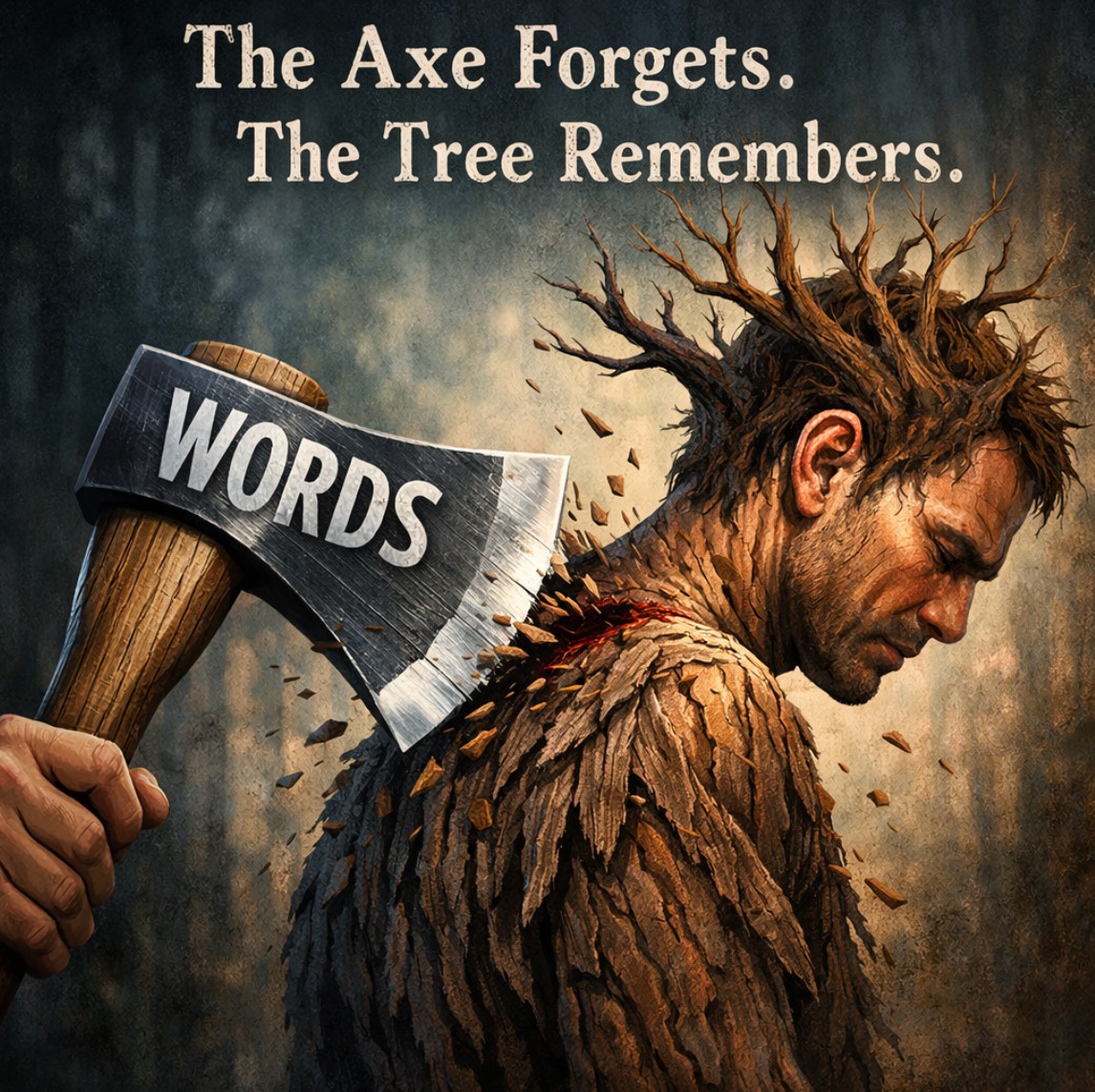
There’s an old proverb:
“The axe forgets; the tree remembers.”
Most people read this as a lesson about tone or delivery.
It isn’t.
It’s about what the axe is.
A negative word is an axe.
Not raised voices.
Not anger.
Not conflict.
A single negative word — spoken casually, jokingly, or “without intent” — is an axe the moment it leaves your mouth.
Words Become Axes the Moment They Cut
The instant a word:
- diminishes
- mocks
- belittles
- shames
- highlights a flaw
…it stops being “just a word.”
It becomes an axe.
You don’t need force.
You don’t need volume.
You don’t need malice.
A light swing still cuts wood.
Whistling Doesn’t Change the Tool
This is where people fool themselves.
They attach a smile.
They add humor.
They soften their voice.
As if a cheerful tone somehow transforms steel into silk.
It doesn’t.
Whistling while you swing does not change the nature of the axe.
A negative word delivered playfully still lands as a blade.
The axe forgets the swing.
The tree remembers the cut.
“I Was Just Joking” Is Axe Logic
When someone says, “I was just joking,” what they’re really saying is:
“I enjoyed swinging the axe and don’t want to own the damage.”
Intent is internal.
Impact is external.
You remember the joke.
They remember the wound.
This Isn’t About Behavior — It’s About Who You Are
Anyone can misstep once.
But repeated negative language — especially casual, joking negativity — isn’t accidental.
It’s a habit of reaching for axes instead of tools.
That’s not about behavior.
That’s about character.
Character is revealed in what you choose not to say.
Never Use an Axe on What Can’t Be Changed
Here’s the hard boundary:
If something cannot be changed, any negative word about it is automatically an axe.
Appearance.
Voice.
Body.
Background.
Innate traits.
There is no constructive version of that sentence.
No growth follows.
No lesson emerges.
Only damage.
That’s not honesty.
That’s harm.
The Moral Is Simple
If you haven’t got anything positive to say —
don’t say it.
Not because positivity is polite.
But because negativity is a blade.
Silence is not avoidance.
Silence is choosing not to swing.
Choose Better Tools
You can speak truth without cutting.
You can give feedback without drawing blood.
You can be sharp without being destructive.
Or you can keep calling axes “jokes” and wonder why people flinch when you speak.
The axe forgets.
The tree never does.
Choose your words like they’re tools —
because some of them are weapons.